Why the App Is the Wrong Unit
- Prem Sundaram

- Aug 5
- 5 min read
Updated: Aug 6

I kept switching note apps. Notion to Obsidian. Obsidian to Apple Notes. Apple Notes to a text file in a folder called 'notes' that I never opened. The notes piled up. The thinking never quite arrived.
I thought the problem was the app. Better search. Better folders. Better sync. So I kept buying better apps. And the pile kept growing, and the work kept getting shallower, and I kept writing notes that no future version of me would ever read.
Then one afternoon I ran out of apps to try. I had a Leuchtturm premium notebook on my desk. I picked it up. I wrote one note on one page. And the next thought came faster than it had in months.
It was not the notebook. It was the unit.
The unit is the trap
A note-taking app is a container. The container does not think. It holds whatever you pour into it — one-line ideas, half-baked rants, copied URLs, screenshots of tweets, voice memos you'll never transcribe. The more the app can hold, the more it does hold, and the lower the cost of dumping something in.
That lower cost is the whole problem. The ease of capture is the enemy of clarity.
There is a version of this on every laptop I have owned. The folder called 'notes' that contains 400 files. The Notion workspace with 80 pages. The Obsidian vault with daily notes stretching back to 2021. Every one of them was full of things I had at one point thought were important. None of them were useful.
I had built a museum of my own attention. And I was its only visitor, and I never came.
Capture is thinking, not storage
The act of writing is not the act of saving. They feel like the same thing — text goes in, text stays there — but they are different cognitive events.
Saving is a write to disk. Writing is a write to memory. When you rephrase a thought into one sentence on one card, you are doing the work of compression. You are choosing which word. You are deciding what the thought actually is. The compression is the thinking. A phrase has been repeatedly coming back to me recently 'are you thinking or just transcribing'. If we use that lens you might find a lot of your 'work' is just saving not creating. Perhaps another way to think of this is are we saving existing neurons or making new ones?!
Most apps skip the compression. You dump a paragraph. You dump a screenshot. You dump a link. The thing is in the system now, but the thought never went through the bottleneck of being forced into a shape. So it does not consolidate. It just sits there, taking up space in the index, becoming drag on every search you ever do.
A small unit forces the compression. One card. One thought. One page. Whatever shape you choose, the constraint is the same: make it fit, or do not write it down.
App-switching is procrastination
I want to name this clearly because I do it more than I would like to admit. Switching apps is a form of procrastination. It looks like productivity. It feels like upgrading. It is neither.
It is the same loop as buying a new notebook. The blank book makes you feel like you are starting over. The new app makes you feel like you are starting over. The empty state is intoxicating. You get to imagine the version of you that uses this app well.
But you will not be that version. You will be the version that learns the new app for two weeks, abandons it, and goes back to the old one. Or to a different new one.
I have done this eight times in the last three years. Each time I lost six months of thinking. The notes were not in the new app. They were in the old one. Or in three old ones.
Why a card works
A card is the smallest unit that can hold a thought. Smaller than a paragraph. Smaller than a sentence, usually. The card does not care about folders, tags, backlinks, or graph views. It does not care about your daily-note template. It just holds the one thought.
When I sit down with a stack of cards, I am not navigating. I am reading. One card. Then the next. The thinking moves at the speed of my eyes, not the speed of my cursor.
And because the unit is small, I can rearrange. I can spread them out on a desk. I can pin them to a wall. I can shuffle them in my hand until the order makes sense. Nobody has ever shuffled a Notion page on a desk.
The physical version of this is obvious. The reason the digital version is hard is that the medium wants to absorb every available space. Apps make more sense with more text on them. Cards make more sense with less.
Where the app helps
I am not anti-app. I am anti-app-as-the-unit. The app is the table you put the cards on. It is the place where the cards live when you are not holding them. It is the search box for the things you wrote down in the third coffee shop on a Tuesday in February.
The right app does three things: it gets out of your way while you write, it lets you find things later, and it does not pretend to be the thought itself.
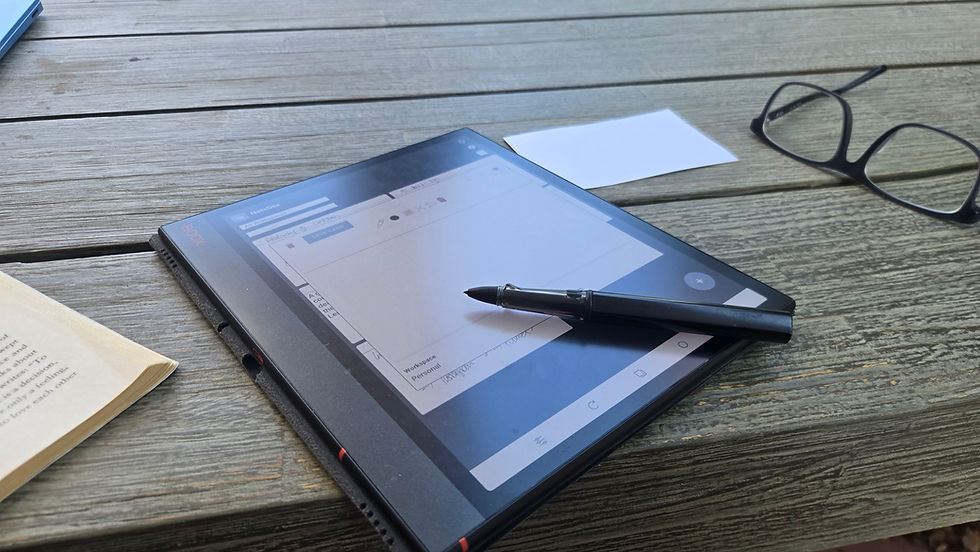
An app that gives you a billion features is not the right app. An app that gives you a small canvas and lets you riff is closer. An app that gives you one card to fill in is the right shape. The shape is the value.
Anything that lets you pour more in faster is the wrong direction. Anything that makes you stop and decide what the thought is, in fewer words, is the right one.
What I do now
I open the app. I write one card. I close the app. That is the workflow.
If a thought is too big for one card, I write more cards. I do not write a longer card. The longer card is the trap. The longer card is what I was doing in Notion for six years.
If I have three cards that I think belong together, I write them on the same desk, not in the same folder. The folder is for filing. The desk is for thinking. The cards are for one thought at a time.
I do not have a system. I have a constraint. The constraint is the system.
Try it
Pick one thought you have been carrying around. Open a notes app — any app, but the simpler the better. Write it on one card. Make it fit. Use one sentence if you can.
Then write the next thought. Then the next. Do not organize. Do not tag. Do not make a folder. Just write cards.
When you have ten, read them back in order. Notice what shows up that you did not know was there. Notice which thoughts were actually one thought pretending to be three. Notice how much faster the next idea comes when you are not deciding where to put the last one.
The app is the wrong unit. The card is the right one. Pick a smaller canvas. Your thinking gets sharper the moment you do.