Why Handwriting Still Works in a Digital World


I stopped writing by hand for two years. The note apps got prettier. The thinking got worse. I had everything — searchable, synced, tagged, color-coded — and I could not tell you what I thought about any of it a week later. Then I picked up a fountain pen on a lark, and the room got quieter. The pen did not change my life. It changed the speed at which I could hear myself think. Here is what I have learned since, and why your brain might be asking you to slow down the same way mine did.
There is a reason typing feels frictionless and reading what you typed a month later feels like reading a stranger's homework. It is not because your notes are bad. It is because the medium quietly stripped out the part of your brain that was doing the work. The work was the whole point.
Are you thinking or just transcribing?
When you tap a key, the resistance is almost zero. The letters appear. The cursor blinks. Your hand barely moves. It feels like productivity, but it is closer to transcription — your fingers are a courier for your thoughts, not a collaborator with them. Pen on paper is different. Pen on paper makes the hand argue with the brain. You slow down. You cross things out. You write the same word three different ways because none of them is quite right.
That friction is not a bug. It is the part of the process where thinking actually happens. Without it, you are just shoveling words into a pile.
Why the brain lights up when the hand moves
Researchers have been putting EEG caps on people for years and the results keep pointing the same way. Writing by hand lights up broad swaths of the brain. Typing lights up a small, efficient cluster. The difference is not just volume — it is the kinds of regions that get involved. Handwriting pulls in motor regions, sensory regions, the parts of the brain that handle space and shape. Typing pulls in the parts of the brain that handle speed.
If you want to remember something, the first set matters. If you want to store something, the second set is fine. Most of us are storing more than we are remembering, and we wonder why nothing sticks.
The alphabet was not designed for thumbs
When you learn a new symbol — a letter, a Chinese character, anything — the act of drawing it with your hand builds connections across visual, motor, and auditory regions of the brain at the same time. Typing the same symbol on a keyboard builds one connection, and it is a thin one. This is why a kid who practices handwriting remembers letters faster than a kid who taps them on a tablet.
As an adult, the act of copying a quote by hand sticks with you in a way that highlighting it never will. The hand is a memory device. We just forgot.
Your notes are not the point
The hardest part of going back to handwriting is the temptation to keep both. The iPad for capture. The notebook for thinking. The Evernote for archiving. The Notion database for organizing. What you end up with is a tax on your future self — every idea has to be copied three times, and by the third copy you are not thinking about the idea, you are thinking about the system.
I lost more ideas to my own tooling in 2024 than to bad memory in 2025. A notebook is allowed to be a notebook. Let it be one thing.
What one card, one thought really buys you
This is the part I did not expect. When you write a thought on a single index card, the card ends. The thought either has to fit or it has to break. Most thoughts, when forced onto a card, shrink to a paragraph. They get sharper. The darlings get cut. The bullet that was going to be a section becomes a sentence. The thing you were going to ramble about for two pages becomes a thesis on the back of a 3x5.
Constraints do not limit thinking. They make thinking possible to ship. A card is the cheapest unit of capturing a thought and making it real and outside your head. That is the entire job of a note.
How to start without making it a project
Buy a cheap notebook. Any one. Do not read reviews. Carry it for a week. Write one sentence a day. That is the whole protocol. The point is not handwriting. The point is the one sentence. The point is the slow return of the hand as a thinking partner, not a courier.
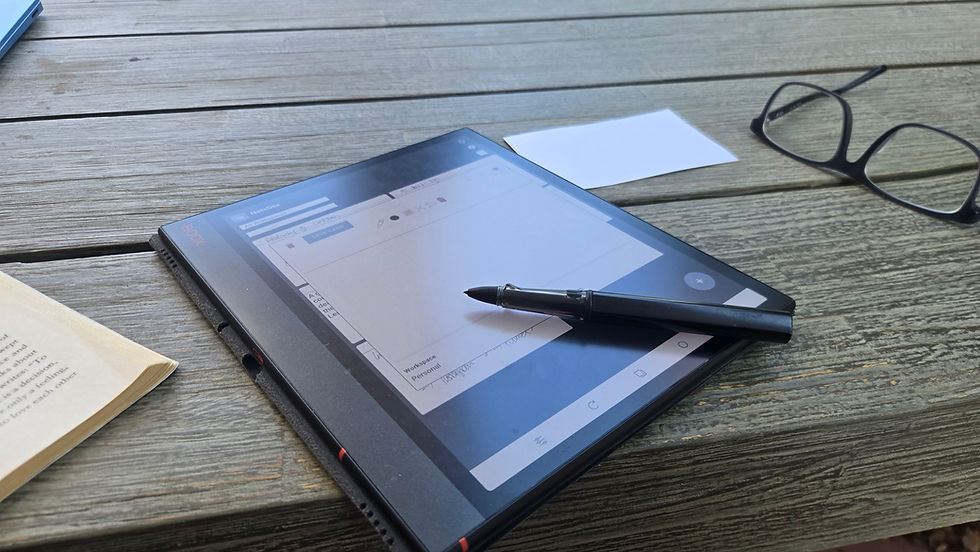
After a week, if the notebook is still empty, you learned that you do not need a notebook. If it is filling up, you learned something else. The previous system that prompted you to open it — the app, the inbox, the meeting — is now in a different place in your workflow. The notes are now the work. The apps are the archive. If you want to do this digitally, you can use NoteDex.
The hand is the only interface that does not lie to you
A keyboard is permissive. It accepts every keystroke with the same flat click. A tablet is permissive. It accepts every swipe, every backspace, every undo without complaint. A pen is honest. If you scrawl, you have scrawled. If you cross out, the cross-out is there. If you write a sentence you are not sure about, the sentence sits there in your own handwriting, looking uncertain, until you decide what to do with it.
That uncertainty, made visible, is a kind of honesty that screens are not built to give you. The screen wants you to keep moving. The page asks you to sit with what you just said. Most of what I have ever figured out, I figured out in the second between writing it down and looking at it. The page is where that second lives.