The Power of the LLM Is the L
- Prem Sundaram

- Jul 27
- 4 min read

There's this line a mathematician said recently that I keep coming back to. He was asked what's the one thing humans still have that AI doesn't. His answer wasn't creativity. It wasn't speed. It was this: we still have to be the ones doing the learning.
The way he put it was — and I'm paraphrasing — the only unique thing about human intelligence is that we hopefully care that humans still exist.
It's a strange sentence to chew on. But I think it's also the most practical one I've heard all year. Because if you accept it, a lot of small decisions get a lot easier.
The fitness metaphor actually lands
He told a story about a kid who decides they're not going to run the mile in gym class. Instead, they're going to drive the car one mile. The kid says: how much exercise did I get? Answer: none. You didn't run anything. You just moved the car.
Same thing happens when an AI writes your essay for you. The essay gets written. The grade gets handed in. But nothing happened in your head. The mile didn't get run.
This isn't a moral argument. It's a fitness argument. The point of the assignment was the mile. The paper was the receipt, not the workout.
Why writing is the actual workout
Here's the part that surprised me. The reason this matters — the real reason, not the school-reason — is that language is the load-bearing thing. LLMs are good at language because language is what they're made of. That's the whole trick.
If the thing you're trying to grow is the thing the AI is best at, then outsourcing that thing isn't a shortcut. It's opting out of the only exercise that builds the muscle.
When you sit down to write a sentence and you can't find the words, that's the rep. When you rewrite the sentence three times and the third one is finally closer to what you meant — that's a set. The AI can do the warmup for you. It cannot do the rep.
Where index cards come in (the reason I'm writing this)
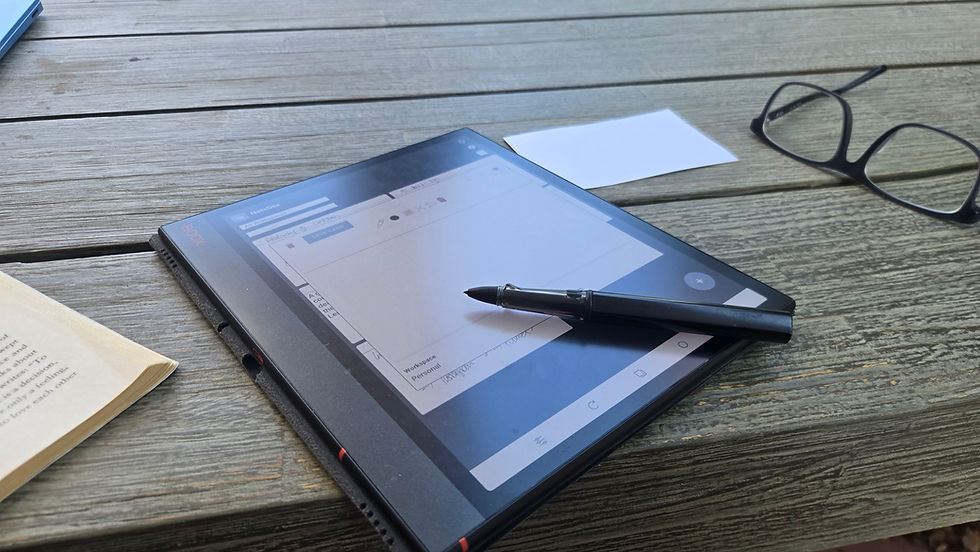
I've been keeping handwritten notes on index cards for many years now. Not because it's faster than Notion. Not because it's searchable. It's none of those things. It's slower than any digital tool. It's harder to find. I can't grep it. I can't Ctrl+F it. (at least not yet!)
I do it because the slowness is the point.
When I have to write a thought on a card — really write it, by hand, in pen, in my actual handwriting — the thought has to survive the trip from brain to hand. It has to be small enough to fit. It has to be specific enough that I can pick it back up tomorrow. It has to be a sentence I actually chose, not a sentence an autocomplete handed me.
That's the mile. The card isn't a note-taking optimization. It's a thinking constraint. The constraint is the workout.
Three small things I started doing differently
Once I took the fitness metaphor seriously, a few habits showed up on their own.
First — I stopped letting AI touch the first draft where possible. Not the second draft. Not the polish. The first draft. The reason is mechanical: the first draft is where I find out what I think. If I skip that step I never find out. I just hand in the AI's thought. What I want is for me to feel involved and steering the outcome in a way that will be 'me'.
Second — I started writing the question before I write the answer. Most of my bad notes started life as answers I was parroting. The ones that lasted started as questions I was actually stuck on. The handwriting slows me down enough to notice which is which.
Third — I stopped calling the AI my writing partner. It's a research assistant. It's a thesaurus. It's a patient first reader who doesn't judge. But it is not the runner. I am the runner.
The thought experiment that changed my mind
Try this: imagine your kid comes home and says they used a calculator for every arithmetic problem in third grade. Then they get to calculus and they genuinely cannot do derivatives because they've never built the number-sense underneath. Would you call that a tradeoff? I wouldn't. I'd call that a missing floor.
Writing is the same kind of floor. If you don't build the sentence-sense — the slow, awkward, can't-find-the-word feeling — you don't have anything to do the higher-level thinking on top of.
The AI isn't wrong. It's just standing on a floor you didn't build.
You can still use it. Just not for the reps.
I'm not anti-AI. I use it daily. I use it to summarize articles I'd never get to. I use it to redraft a paragraph I'm stuck on. I use it to figure out what the counterargument is to my own position. All of those things are useful. None of them are running the mile.
The line I'd draw is small. Try to use AI for everything except the first sentence. Write the first sentence yourself. Write the last sentence yourself. The middle can be whatever you want. And maybe this is not for everyone all the time but for really important things, try.
If you're the kind of person who reads this and thinks — I don't write anyway, I just want to get the work done — I think the mathematician would say that's exactly the person who most needs to write.
What the index card is actually for
An index card is the smallest possible surface that still counts as writing. Not a doc. Not a thread. Not a Slack message. A card. It holds one thought. One question. One observation that I had to be slow enough to write down.
NoteDex is what I built when I wanted the digital equivalent. One card, one thought. Quick to capture, slow enough to matter. Constraint as feature, not bug.
If the only unique thing about humans is that we run the mile ourselves — fine. I'll keep running. The cards are how I keep count.