What Your Brain Forgets About Your Projects
- Prem Sundaram

- Jun 29
- 4 min read

I lost a project last week. Not the work. The reason I was doing it. I had the file open, the deadline in front of me, the next action sitting in my inbox — and I could not, for the life of me, remember why any of it mattered. I closed the laptop. Made coffee. Stared at the wall. Opened the laptop again. Same blank feeling.
It used to be that I'd blame myself for this. Lazy, scattered, no follow-through, all of that. Then I watched a long conversation with five neuroscientists and realized: the brain is not a filing cabinet. It was never designed to hold onto the reason behind your work for weeks at a time. Every system that attempts to fix this — the apps, the reminders, the second brain — is just trying to help fill this 'meaning gap' - but the solution is wrong.
The brain isn't a computer — it's an actor
One of the things that surprised me most from a recent neuroscience panel is the way the researchers keep pushing back on the computer metaphor. The brain doesn't sit there receiving information and storing it. It generates predictions and tests them against what comes back. It learns by acting, not by absorbing. Knowledge isn't poured in — it's built up through the loop between what you do and what happens next.
If that's true, then a project file on your laptop is a strange object. It's static. It's passive. It expects the brain to keep remembering why it's there, while the brain is actively trying to forget. No wonder the file sits untouched for three days. No wonder the reason fades.
Why projects lose their meaning
Memory researchers describe a process called consolidation. The brain takes short-term impressions and turns them into long-term ones — but only when the right signals fire. One of those signals is emotional weight. Another is repetition. Another is a story you keep telling yourself about why this thing matters.
When you start a project, the reason is loud. You tell everyone. You write it down. By week two, the reason is silent. The work is still there, but the story behind it has been discarded as redundant information. Your brain moved on. The project didn't. The gap between those two things is where most abandoned work lives.
The case for writing the reason on a card
An index card forces the brain to do something the laptop doesn't. To state the reason in one place, in your own hand, in words a future-you can read in five seconds. It's not a task list. It's a memory aid in the literal sense — a prosthetic for the consolidation step.
When I write 'why this matters' on a card and pin it next to my screen, I'm not being organized. I'm re-running the consolidation signal every time I glance at it. The brain hears the same story again. The project stays connected to the meaning behind it. The work resumes without the three-day staring-into-the-coffee phase.
What speech decoders and index cards have in common
The researchers I watched are building brain-computer interfaces that decode intended speech and write it on a screen. The patient thinks the sentence; the system displays it. It's a prosthetic for an output the brain can produce but the body can't deliver.
An index card is the same thing, scaled down. The brain knows why the project matters but can't always retrieve it on demand. The card surfaces the intent at the moment the brain is ready to act. The pattern is identical: externalize something the brain is good at producing but bad at recalling, in a form a person (or a patient) can read in real time.
Why smaller is better than smarter
The temptation, when the brain drops the reason for a project, is to reach for a more powerful system. A bigger app. A more connected second brain. A longer template. The science points the other way. The brain is bad at retrieval under load. Every additional layer of structure adds load. The card wins because there's nothing to load. Five seconds. One reason. Back to work.
The neuroscientists on the panel kept using a word: simple. The best prosthetic is the one the patient actually uses. The best memory aid is the one you don't have to learn. The best index card is the one with a single sentence you wrote yourself.
What to do on Monday
If you have a project that lost its reason this week, write the reason on a card. Not in an app. Not in a Notion page. On a piece of paper, in your own hand, in words a version of you who's three coffees deep can read without thinking. Pin it where you'll see it when you sit down to work tomorrow. (or, create a NoteDex card and pin it on your Windows desktop!)
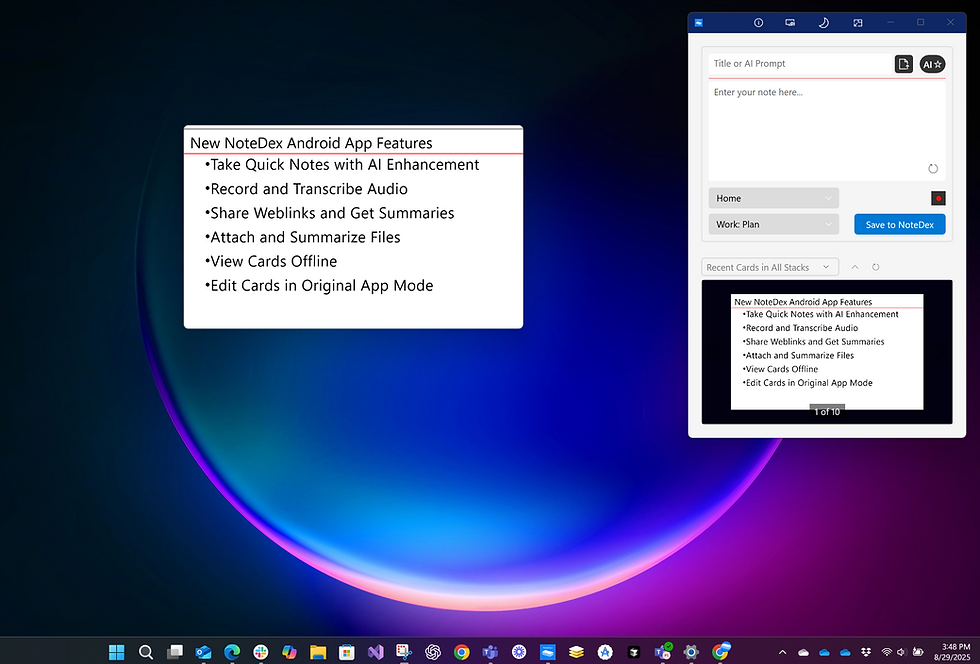
Then start. The reason is no longer in your head, where it was always going to fade. It's in a place your eyes can reach in half a second. The brain can stop trying to remember and get back to doing the thing it was always going to do anyway: act, observe, learn, act again.
That's the loop. The reason isn't a thought you hold. It's a card you can see. The work is what you do in between.