What Happens to Your Brain When You Write by Hand
- Prem Sundaram

- Jun 18
- 4 min read
Updated: Jul 22

I'll be honest — I type more than I write. Every meeting. Every idea. Every note in my own app. I told myself it was efficient. The same lie a lot of us tell.
Then I read a stack of neuroscience research about what actually happens inside your brain when you put a pen to paper, and I haven't looked at a laptop the same way since.
The short version: your hand isn't a slower keyboard. It's a different instrument entirely. And the science on what it does to your brain is hard to argue with.
Two students. Same lecture. Two different brains.
Picture this. Two university students. Same professor. Same material. Equal intelligence. Equal interest. One is holding a pen over lined paper. The other has their fingers hovering over a laptop keyboard.
When researchers scanned their brains during the lecture, the difference was stark. The student writing by hand showed coordinated bursts of activity across multiple regions — what researchers describe as a synchronized neural ballet. The student typing showed isolated flickers. Activity, but disconnected.
Same information going in. Wildly different brains lighting up to receive it.
The 20% advantage you can't type your way out of
Back in 2014, a pair of researchers at Princeton designed a clean experiment. Students watched TED talks and took notes. Half wrote by hand. Half typed on laptops. Then everyone took the same test.
The handwriters scored around 20% higher on conceptual questions. Not a small bump. A dramatic one.
And here's the kicker: the laptop students weren't lazy. They actually wrote more. Longer notes, more detail, more verbatim transcripts of the lecture. And they still remembered and understood less.
Why? Because when you type fast enough to capture everything, you stop processing. You become a transcriptionist. The handwriter can't keep up — so they're forced to summarize, decide what matters, rephrase in their own words. That struggle is the learning.
Your brain treats the pen like a priority filter
There's a network in your brain called the reticular activating system. It decides what gets your attention and what gets ignored. Writing by hand switches it on in a way typing doesn't.
When you physically form each letter, you're sending your brain a signal: this is important. Pay attention. The act of moving the pen across the page is your brain tagging the information as worth keeping.
Typing doesn't trigger that same signal. Every key feels the same to your brain. A grocery list and a deep insight both go in via the same uniform taps. The pen is biased. The keyboard is neutral. And that bias is doing real work in your memory.
Motor memory: why the physical motion matters
When you write a word by hand, you're not just thinking about it. You're also moving your fingers, wrist, arm in a specific pattern. That motor pattern gets encoded alongside the meaning.
So when you try to recall the information later, your brain has more than one retrieval cue. It can pull it up through the motor memory of writing it, the visual memory of seeing it, and the conceptual memory of deciding what to write.
Multiple paths in. Easier to find it later. This is part of why students who take handwritten notes retain more than those who type — the information has been encoded through more channels.
The right hemisphere: where creativity lives
Handwriting engages the right hemisphere of your brain — the side that handles imagination, visual thinking, and artistic processing. Typing is a left-hemisphere activity: linear, linguistic, sequential.
When you're drafting a story, sketching a new idea, working through a problem that doesn't have a clear answer yet, the right hemisphere is the one doing the heavy lifting. The pen gives it room to work. The keyboard does not.
This is why so many writers and designers still reach for a notebook before they reach for a screen. The medium isn't incidental. It changes which part of the brain runs the show.
Stress goes down. Neural connections strengthen.
There's also a stress angle. Studies on expressive writing — journaling about your feelings, even for just 15 minutes a day — have shown measurable drops in amygdala activity. The amygdala is your brain's threat detector. It runs hot when you're anxious, overwhelmed, ruminating.
Writing your thoughts down quiets it. Not by solving the problem. By getting the loop out of your head and onto the page where your brain can stop rehearsing it.
And over time, all of this — the focus, the motor encoding, the right-hemisphere work, the stress relief — adds up. Neuroplasticity. Your brain physically reorganizes itself based on what you do with it. Handwriting is one of the few daily activities that activates so many systems at once.
What this means for the way you work
I'm not going to tell you to throw out your laptop. That's not the point. The point is that the all-typing-all-the-time default is leaving a lot of cognitive performance on the table.
A few small shifts that work for me:
• Capture first thoughts by hand. Before I open a doc, I write the rough version in a notebook. The slowness forces me to think before I write.
• Use pen and paper for anything I need to actually remember. Names, ideas, decisions, the question I want to ask someone. The keyboard doesn't encode it the same way.
• Keep a small notebook within arm's reach. Not for productivity theater. Because the moment I have a pen in my hand, my brain knows the mode has changed.
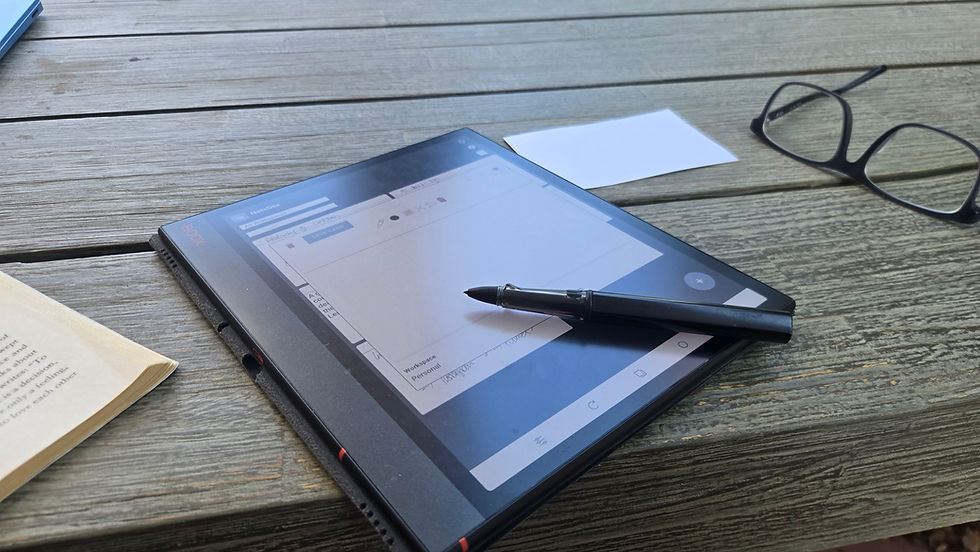
• Consider also a hybrid approach - purchase a tablet like an Apple iPad or Samsung Galaxy Tab or Boox Note Air 5c and download NoteDex. NoteDex supports handwritten Index Cards so you can ditch the physical notebook and also use handwriting. Cards can support both text and handwriting - the best of both worlds.
NoteDex is can be your one stop memory center — not just the capture, the search, the cross-device sync, the structure. But also the trigger, the part where the idea actually lands in your brain, can still analog with a digital twist. The two work better together than either does alone.
If you've been feeling like your notes aren't sticking the way they used to, the problem probably isn't your tool. It's the medium. The pen is still doing something your keyboard can't.
Pick up a pen enabled tablet and download NoteDex today. Your brain will know and feel the difference!