What Are Bullet Journals, Really? The Method Behind the Hype

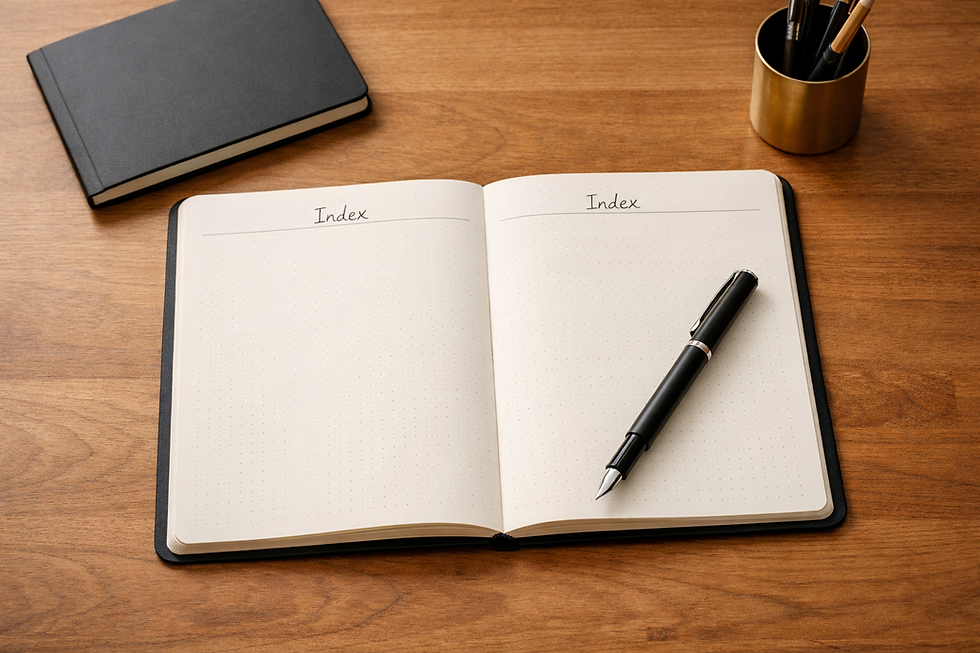
Is this you?
"I bought the Leuchtturm. I bought the Hobonichi. I drew the perfect index page. Then the system died in three weeks. — again."
If that sounds like you, the problem wasn't you. The system was doing exactly what it was designed to do: collapse when it stopped being a tool and started being a project. And if you have no idea what we are talking about, also read on!
Bullet journaling works — but only if you understand what it actually is. And almost no one explains that part.
What a bullet journal actually is
A bullet journal is a notebook organized around a small set of repeated collections. You set up an Index, a Future Log, a Monthly Log, and a Daily Log. Everything else is optional. The whole system lives in one notebook. There is no app, no subscription, no backup. There is also no magic.
The system was created in 2013 by Ryder Carroll, a digital product designer, as a way to manage task overload without a phone. The core idea: externalize what your brain is trying to remember, in the simplest possible structure, using a single short line for each thought (a “bullet”). Tasks get one symbol, events another, notes a third. The point is to write fast and reflect later.
That’s it. The five collections. The signifiers. The migration. Everything else — the washi tape, the color coding, the month-end reflection spreads — is decoration. The system works or doesn’t based on the practice, not the notebook.
Why the method keeps coming back
Bullet journaling had its peak in 2017–2019 when Instagram turned the practice into an aesthetic. Then it crashed. By 2022 most of the “BuJo community” had moved on, burned out on the perfectionism.
What’s interesting is what came next. The community is back — not as an aesthetic, but as a practice. In 2025 the official Bullet Journal program launched three structured plans (Foundation, Transformation, and Certification) for the first time, treating the method as a “lifelong practice of intentional living” rather than a productivity hack.
The reason: people are tired of app fatigue. Every six months there’s a new “second brain” app, a new “AI journal”, a new task manager with kanban views. The notebooks aren’t fighting the apps. They’re doing the thing apps can’t: turning writing into a quiet ritual.
The 5 collections in 10 minutes
Here’s the actual setup. Five collections, ten minutes, no perfectionism.
• Index. The first spread. A list of topics with page numbers. You fill it in as you go. It’s your table of contents.
• Future Log. The next six months, divided into six boxes. Anything scheduled past this month goes here. You migrate it forward at the start of each new month.
• Monthly Log. The current month. Left page is the timeline — a list of dates and days. Right page is the action plan — the things you want to do this month, organized by personal and work.
• Daily Log. The current day. Open the spread, write today’s date, pull in tasks from the monthly action plan, add anything else. This is the page you actually write on.
• Custom collections. Optional. A reading log. A training plan. A project tracker. Any topic that needs its own space.
If you can write a grocery list, you can do all five. The whole setup, literally, is ten minutes of work. The hard part isn’t the setup. It’s the practice.
(Hm... looks like checklists on index cards, right?)
Where bullet journaling fails
It fails predictably, in the same ways, for the same reasons.
Migration dies first. The monthly ritual of moving tasks from old monthly logs into the new one takes 30 minutes. Most people skip it after month three. Once migration dies, the future log stops being useful. Once the future log dies, the system is just a daily to-do list with extra steps.
Search dies next. You write a brilliant idea in March. You can’t find it in July because you don’t remember which page. The index is supposed to help, but a paper index can’t be searched. “Did I write about X?” requires flipping.
Volume dies last. A 200-page notebook fills up. If you’re a heavy writer — say, a writer, a researcher, a founder, a student in finals week — a paper notebook can’t keep up. You run out of monthly log spreads. You have to start a new notebook and migrate again.
The diagnosis is the same in every case: the notebook ran out of the thing the notebook can’t do. The fix isn’t to try harder. The fix is to change what the notebook is asked to do.
The hybrid: a notebook for thinking, an app for remembering
Almost every productivity system fails because it asks one tool to do two things. The notebook can’t search. The app can’t make you think.
In the past year, hybrid journaling has become the default — not because it’s trendy, but because paper and software solve different problems. You keep the notebook for the parts that need slow thinking: the morning pages, the project sketches, the weekly review. You let the app handle the parts that need fast retrieval: search, reminders, recurring tasks, cross-device sync.
If you have ADHD (and Ryder Carroll has spoken openly about his own), the analog ceiling hits hardest. The notebook captures the idea, but it can’t remind you about the idea at 4pm. The app can remind you, but it can’t capture the idea the way a notebook does. Pair them and the system becomes sustainable.
Most people don’t need to choose paper or app. They need to choose which tool owns which job.
Try it in five minutes
You don’t need a new notebook to start. You need one page.
1. Get a piece of paper. Title it “Index.” Draw a line down the middle. On the left, write “Topic.” On the right, write “Page.”
2. Write today’s date as a new heading. Underneath, rapid-log five things on your mind right now — one line per thing, no editing.
3. Add a topic to the index pointing at today’s page. “Today, p.1.”
4. Set a reminder on your phone for one week from now: “Open the page. Read what you wrote.”
5. After a week of doing this, decide if the system is worth keeping.
If it’s not, you’ve lost five minutes. If it is, you’ve just built a daily practice. That’s the whole thing.
If you want the practice without the paper ceiling
NoteDex is built around the same idea Ryder laid out in 2013: one short line per thought, organized into collections, indexed so you don’t lose anything. We just use index cards instead of notebook pages — one card per project, one card per idea, search by topic or status instead of by page number.
It’s the part of the bullet journal that works, without the migration, the lost pages, or the “where did I write that?” that kills the paper version after six months.
Just create cards and use the checklist feature to generate multiple cards for the various collections:

Free Trial on iOS, Android, Mac, Windows and web. Try it for a week and see if your daily log actually holds!
— Prem