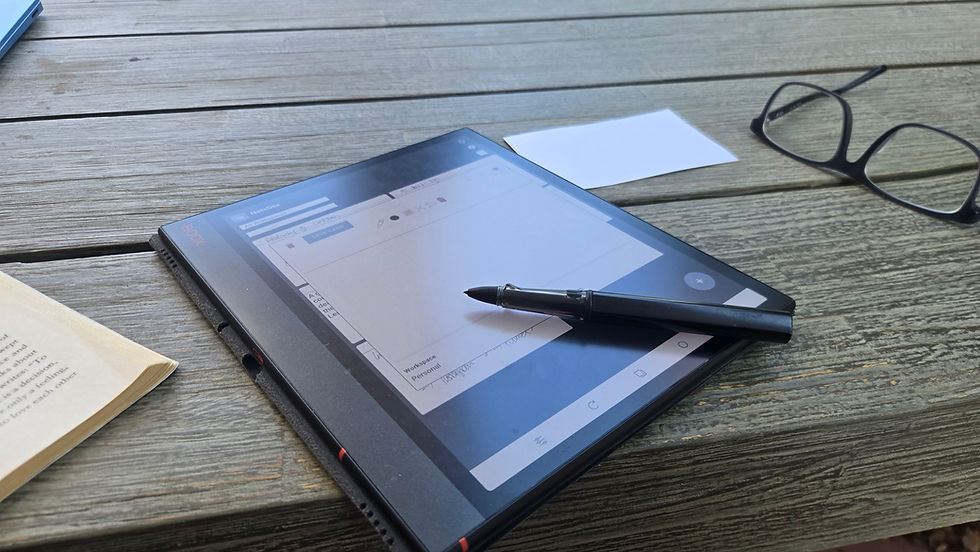
Visually Information Rich - By Design
- Prem Sundaram

- Jun 17
- 4 min read
Updated: Jul 23

I lost an idea last week.
Not the work. The picture of the idea. I'd sketched a quick diagram on a card, set it on my desk, and by Thursday the card was under a coffee cup and the diagram was gone. I remembered the words. I did not remember the shape.
That's when it hit me: a lot of what I think I am forgetting is not the text. It is the image. The little arrow that connected two ideas. The scribbled margin note. The way a list of bullet points looked like a tree when I drew lines between them.
Most note apps give you text. Some of them give you structure. Almost none of them give you back the way an idea actually looks in your head.
Picture is worth a thousand words. So why do most notes throw the picture away?
There's a famous line — usually misattributed to Confucius, actually a 1920s advertising man — that a picture is worth a thousand words. It's true, but not for the reason people think.
A picture is not faster than a thousand words. A picture is faster than the wrong thousand words. When you sketch a process, you skip the part where your brain has to convert a verbal description into a spatial mental model. You are doing that conversion already, on paper, in seconds.
The cognitive scientist Barbara Tversky spent forty years showing this. Her work on diagrams in everyday life found that people use sketches to think, not just to communicate. A quick arrow says "because". A circle around two things says "these go together". A line drawn from one card to another says "this idea feeds that one".
When you type instead of sketch, you lose all of that. You are forced to write out what a picture would have shown in a glance. Then later, when you come back to read what you wrote, you have to reconstruct the picture in your head again.
Handwriting leaves a fingerprint your keyboard doesn't
There's another thing handwriting gives you that typing does not. It leaves traces of how you were thinking.
The size of your letters. The pressure of the pen. The crossed-out word you kept reading anyway. The margin scribble in a different color you came back to at 11pm. These are not decoration. They are evidence of attention.
When I read a typed note from a year ago, I cannot tell the difference between the line I wrote confidently and the line I was guessing at. When I read a handwritten card, the difference is right there in the strokes.
A 2014 study by Mueller and Oppenheimer found that students who took notes by hand — not on a laptop — did better on conceptual questions later. The reason wasn't speed. It was that handwriting forces you to summarize, to choose what matters. Typing lets you transcribe. Handwriting makes you translate.
Why NoteDex is built around the picture, not the page
NoteDex was built around a simple bet: people think in shapes, not just sentences.
Every card in NoteDex has a thumbnail. You don't have to click into a card to see what it looks like — you see it the way you wrote it, on a grid, with the handwriting and the sketches visible. That's not a feature. That's the whole point.
When you scroll your notes, you are not scrolling text. You are scrolling a wall of small images. The same way you'd scroll a wall of index cards on your desk. The visual rhythm is the memory cue.
And when you search, you don't just get the words. You get the cards that match. With the writing still on them. So you recognize them, not just retrieve them.
What changes when your notes look like your thoughts
I have been using NoteDex every day for two years. Here is what I have noticed.
I forget fewer connections. I used to remember the project, but not which idea went with which other idea. Now I see them laid out and the link is right there.
I write less and remember more. Because the picture carries the meaning, I don't have to over-describe in words.
I come back to old notes. A typed wall of text is hard to re-enter. A card with a sketch and a couple of words is easy to pick up. I can be back inside the idea in ten seconds.
The boring truth about why paper keeps winning
People keep coming back to notebooks, even after a decade of "second brain" apps. It's not nostalgia. It's that paper shows you the picture.
A notebook is a stack of small images. You can flip through it in a few seconds and your visual memory does the rest. You remember where on the page something was. You remember what page was next to what page. You remember the color of the pen.
Most apps throw that away. They show you a list of titles. Maybe a preview. Usually not even the handwriting.
NoteDex is the closest I have found to paper, on a screen. The cards are small. The thumbnails are real. The visual density is preserved.
If your notes feel dead, try adding a picture
Here is the simplest test you can run today.
Open any note app. Open one of your older notes. Look at it.
If all you see is a wall of text, that is a wall of words. You will scan it, find the line you needed, and close it. You will not remember it tomorrow.
Now draw a circle around two things in that note. Draw an arrow from one idea to another. Scribble a tiny diagram in the margin.
Come back tomorrow. The picture is what you will remember first.
That is what NoteDex is built around. Notes that look the way you think. Not notes that look the way a word processor thinks.
Try NoteDex free for 7 days → notedex.app