I Tried OneNote on My Boox First. Here's Why NoteDex Worked Better.

Updated: Jul 24

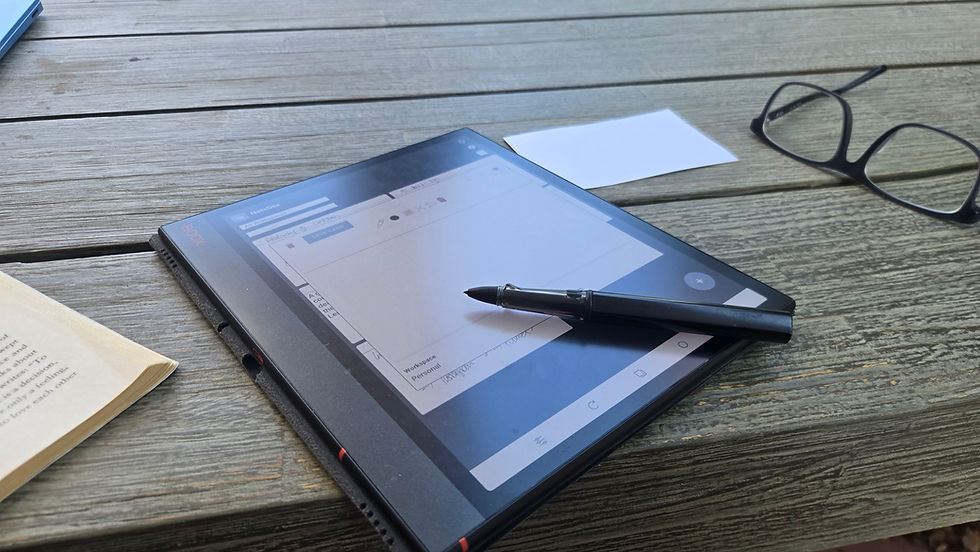
I bought a Boox Note Air 3C about eight months ago. I'd read the same article everyone reads — the one that says e-ink is the productivity tool you didn't know you needed — and I pictured myself writing on it for hours a day. I'd take it to coffee shops. I'd take it on flights. I'd finally get my notes out of my phone.
It didn't go that way. I installed Microsoft OneNote, the way the article suggested, and for about three weeks everything was great. Then I noticed I wasn't using it. The device was sitting on my desk, charged, the stylus next to it, and I was reaching for my phone instead. The Boox was a $500 reading tablet again.
I almost sold it. Then I tried NoteDex — the app I help build — on the same screen, and the device came back to life. Here's what was different, and why I think it's not just me.
What OneNote does well on a Boox
Let's be clear: OneNote is a great app. The reason the Android Police article landed for me is that the basic pitch is right. A 10-inch e-ink screen is closer to a piece of paper than anything else you can carry around. The stylus works. The handwriting recognition is good. Battery life is measured in days, not hours. The whole device is portable, light, and disappears in a messenger bag.
If you already use OneNote on your laptop and your phone, having it on a Boox is genuinely useful. You can read notes, you can jot something down, you can sync across devices, and the screen doesn't kill your eyes. The setup works.
The setup also runs out of steam the moment you actually try to think on the device.
What broke for me
OneNote is built around pages. Sections, pages, sub-pages, a tree of documents. On a laptop, that structure is invisible — the sidebar hides it. On a 10-inch e-ink screen, the structure is the whole experience. Every time I sat down to write, I had to decide which page to put the note on, which section that page lived in, and whether I'd find it again later.
On paper you don't make that decision. You write in the notebook you have open. On an iPad the decision is small — the app is fast, the keyboard is there, you can search. On a Boox the decision is large. The refresh rate of the screen punishes fiddling. The cost of context switching is higher. Every time I asked myself "where does this go?" the device lost a little more of its appeal.
The other thing that broke: the page metaphor itself. A OneNote page is a long scroll. On an iPad you scroll with your finger and the speed matches your intent. On e-ink, scrolling through a long page is slow and visually noisy. The device is great at showing one page-sized thing on the screen. It's bad at everything else.
Why index cards fit the screen
A NoteDex card is the size of a real index card. The app is designed around that — one card on the screen at a time, tap to flip to the next, swipe to go back. The metaphor matches what e-ink is good at. The page you see is the only page you're working on. The cost of switching is just a tap.
There's no "where does this go?" question. You make a card, you title it later if you want, you stack it under a topic. The structure builds itself as you go. The note-taking flow on a Boox is the same as on a phone, the same as on the web — but it feels native in a way a long-page app never did on the same screen.
The other thing I didn't expect: cards on e-ink look right. The proportions match. A card is roughly the same shape as the page. The whitespace is built in. The Boox goes from being a tablet I'm trying to write prose on, to a stack of small pages I'm flipping through. The hardware and the format agree with each other.

What changed in my daily use
After two weeks of NoteDex on the Boox, the device was the first thing I picked up in the morning, not the last. I'd jot three cards while the coffee was brewing. I'd flip back through yesterday's cards during a break. I started using the Boox in meetings again, for the actual quick notes that used to go on my phone and then disappear.
The big shift wasn't features. NoteDex on a Boox is not dramatically more powerful than OneNote on a Boox. The shift was friction. The card format lowered it to the point where the device made sense as a thinking tool, not just a reading tool.
I still keep the native Boox notes app for long freeform writing — meeting notes where I want one continuous page, a multi-page document I'm drafting — and the share-to-NoteDex workflow means those notes become cards when I want to organize them. The two apps do different jobs. Both work.
Is this for you?
If you already use OneNote and your workflow is section-based — a few big projects, a few big documents, not a lot of new pages — OneNote on a Boox is a fine fit. The setup works for that kind of use. Don't fix what isn't broken.
If you tried OneNote on a Boox and bounced off the same way I did, the answer probably isn't a different laptop app. The answer is a different unit of thought. Cards instead of pages. Stacks instead of sections. The app matches the device, the device matches the metaphor, and the metaphor matches the way you actually think when you're not in a structured meeting.
The Boox is back. I'm not selling it. NoteDex is on the home screen, the stylus lives on the side, and the device earns its place on my desk. That's the part I didn't expect when I bought it.
Try it on your Boox
NoteDex is free for 7 Days on Android, and also iOS, Windows, Mac, and the web. Install it on your Boox, sign in to your account, and your cards sync across every device you own. The Android app is the one built specifically for the stylus-first workflow on Android based e-ink devices— try it for a week and see if your e-ink device earns its place the way mine did.