Handwriting not Typing


I type for a living. So do you. So does everyone who has touched a keyboard since about 1995. And we have been quietly convincing ourselves that the keyboard is just faster, that the only difference between typing and writing is the speed at which letters appear on the screen.
It is not. The difference is what happens in your head. And the difference shows up in the brain in ways that are hard to argue with.
There is a recent neuroscience study — high-density EEG, 256 electrodes, real university students in a real lab — that compared what happens in the brain when you write a word by hand and when you type the same word on a keyboard. The handwriting condition lit up brain regions the typing condition did not touch. Connectivity between regions. Coordination across hemispheres. The kind of wiring the brain uses when it is laying down a memory.
I read it and thought: yes. That is what I have felt for years without being able to name it.
The keyboard is fast. The hand is a memory device.
Here is the basic claim, and it is one I want to take seriously even if it is uncomfortable: typing puts words on the screen. Handwriting puts them in your head.
You can verify this with the worst lecture note you ever took. I have a stack. Most of them are on a laptop. I remember almost none of them. The notes I took by hand, with a real pen on real paper, I can still find my way back into. The page opens and the room opens with it. The teacher's voice, the question that came up, the half-formed thought I had at the back of my head while they were talking — it is all still in there, tangled up with the loops of the letters I wrote.
The neuroscience backs this up, and not in a hand-wavy way. When you ask the brain to form a letter by hand, you are asking it to coordinate vision (the word on the page in front of you), motor planning (the shape of the letter), fine motor control (the precise movements of the fingers), and proprioception (the feedback from the hand about where it is in space). Each of those streams is small on its own. Together, they form a pattern in the brain that is rich enough to encode.
When you press a key on a keyboard, the finger does the same thing it does for every other key. There is no shape. There is no proprioceptive surprise. The letter on the screen is the same letter you pressed; the brain gets a single channel of input where the handwriting condition gave it four.
What "connectivity" actually means
EEG studies talk a lot about connectivity, and the word can sound like a jargon cover for nothing. It is not. Connectivity in this context means: are different parts of the brain talking to each other in coordinated patterns? And when they are, what frequencies are they using?
The handwriting study found widespread theta and alpha connectivity — meaning brain regions in the parietal and central areas of the brain were syncing up at theta frequencies (the slow rhythms associated with memory formation) and alpha frequencies (the rhythms associated with attention and long-term memory). When the same participants typed, those connectivity patterns showed up weakly or not at all.
Theta in particular is interesting. Theta is the band the hippocampus uses when it is laying down new memories. When the brain is doing something the hippocampus cares about — the rhythm binds together what is happening in the cortex into a single, encodable event. Handwriting trips that wiring. Typing does not.
What this means, plainly, is that when you write a word by hand, you are not just making a mark. You are creating the conditions under which your brain tags that word as something worth remembering. When you type the same word, you have put the word on a screen, but you have not given your brain a reason to keep it.
Why I keep a paper notebook next to my laptop
I keep both. I have a beautiful brass pen and a Muji notebook on the desk where I work, and I have a laptop with a mechanical keyboard and three monitors. They are not in competition; they do different jobs.
The laptop is for capturing. The notebook is for thinking. When I am in a meeting and someone says something I am going to need to act on later, I write it in the notebook. When I am transcribing something I am going to look up online, I type it. The split is not arbitrary — it is exactly the split the brain research predicts. The laptop is a filing system. The notebook is a memory device.
The paper notebook has another property the laptop does not. It is a physical object I can flip through. I can put a sticky note on a page. I can dog-ear a corner. I can lay two pages next to each other. These are not small affordances. They are the kind of low-level spatial memory cues that the brain is wired to use. Where something is on a page, or in a stack of pages, is part of how the brain stores it. The infinite scroll of a digital notes app gives you none of that.
The honest version of this: my paper notebooks are the only notes I have ever gone back to years later and been glad I had.
What about typing notes during a lecture?
There is a counterargument here that I want to take seriously. A lot of people type notes in lectures because they can keep up. If you try to write by hand during a fast lecture, you fall behind and you cannot capture the full thing.
But the question is not whether you can capture the full thing. The question is whether the goal of note-taking is to capture the words the lecturer said, or to capture what the lecture made you think. If it is the first, you want a keyboard. If it is the second, you want a pen. The neuroscience is clear on this: which tool you use changes what you remember.
And the second version is, almost always, the version that matters a year later. You will not remember the lecturer's exact words. You will not even remember their main argument in clean form. What you will have is the half-formed thought you had at the back of your head while they were talking — the thing the lecture made you think of that had nothing to do with the lecture. That is the thing worth keeping. The pen keeps it. The keyboard does not.
What about digital pens?
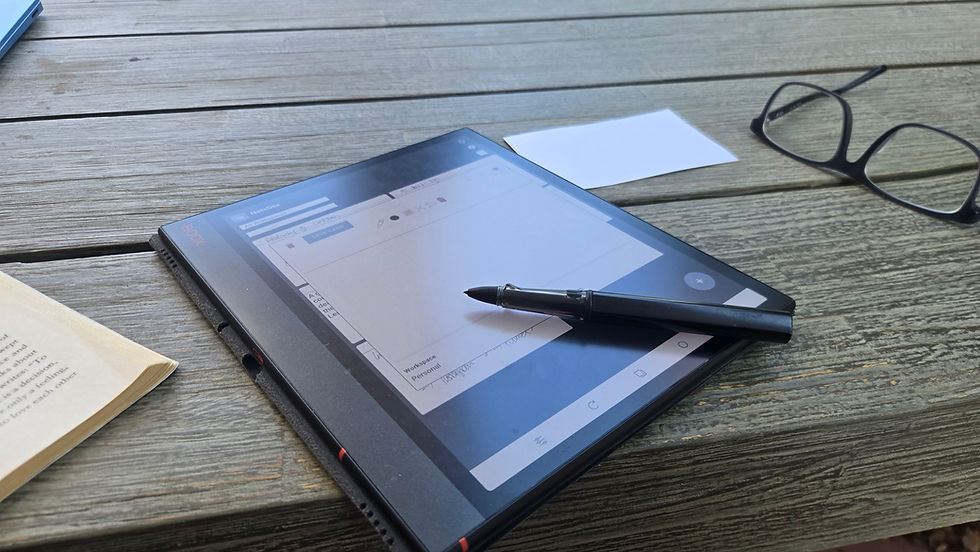
There are studies that show digital pens capture some of the benefit of handwriting, especially when the writing is the same physical act (forming letters with a stylus on a screen). The research on digital pens is more mixed than the research on paper and pencil, but it leans toward: some benefit, less than paper.
My guess, having used both, is that the difference is real but small. The act of marking a page is still the act of marking a page. The act of flipping backward through what you wrote last week is not the same on a screen as it is on paper. So the digital pen is a real upgrade over the keyboard for memory purposes. The paper notebook is the top of the line.
If you are not going to keep a paper notebook — fine, keep a digital one. The point is not that paper is sacred. The point is that writing is doing something your keyboard is not doing, and giving that up costs you something.
Why we ditched handwriting in the first place
We did not ditch it because we discovered it was worse for memory. We ditched it because keyboards are faster, more searchable, and easier to share. Those are real advantages. None of them have anything to do with memory.
The mistake was treating handwriting and typing as the same task with different speeds. They are not the same task. They are different tasks that happen to involve producing the same output. One is a capture operation. The other is an encoding operation. We replaced the encoder with a faster capture tool and lost something on the way out.
I do not think we should put the keyboards away. I do think we should keep a pen. The note-taking app on your phone is a fine recorder. It is not a memory device. Your hand is the memory device. Use it.
Trying it for a week
If you have read this far and want to try the handwriting thing, here is the smallest version of the experiment. For one week, carry a small notebook with you. Not a big one. A pocket one, the size that fits in a back pocket. Use it whenever you would normally type a note to yourself — a thought in a meeting, an idea in the shower, a thing to remember at the grocery store.
Just a sentence. You do not have to write paragraphs. You do not have to organize. You are not making a journal. You are using a pen the way you would use a reminder app, except the reminder lives in your head instead of in your phone.
At the end of the week, look back through the pages. Then try the same experiment with the phone-only habit. The difference in what you remember is going to be obvious, and you are going to feel slightly embarrassed that you ever gave up the pen.
The card is the constraint (again)
Everything I keep writing about — note-taking, journaling, outlining, capturing ideas — comes back to the same insight. The constraint is the tool. A tool that is too easy to use teaches the brain that what it produces is not worth keeping. A tool that asks for the slow, deliberate act of forming letters by hand tells the brain the opposite.
If you want to remember something, write it by hand. If you want to look something up, type it. If you want to think, take out a notebook and a pen.
Your handwriting is slow, awkward, and not searchable. This is, on reflection, a feature.